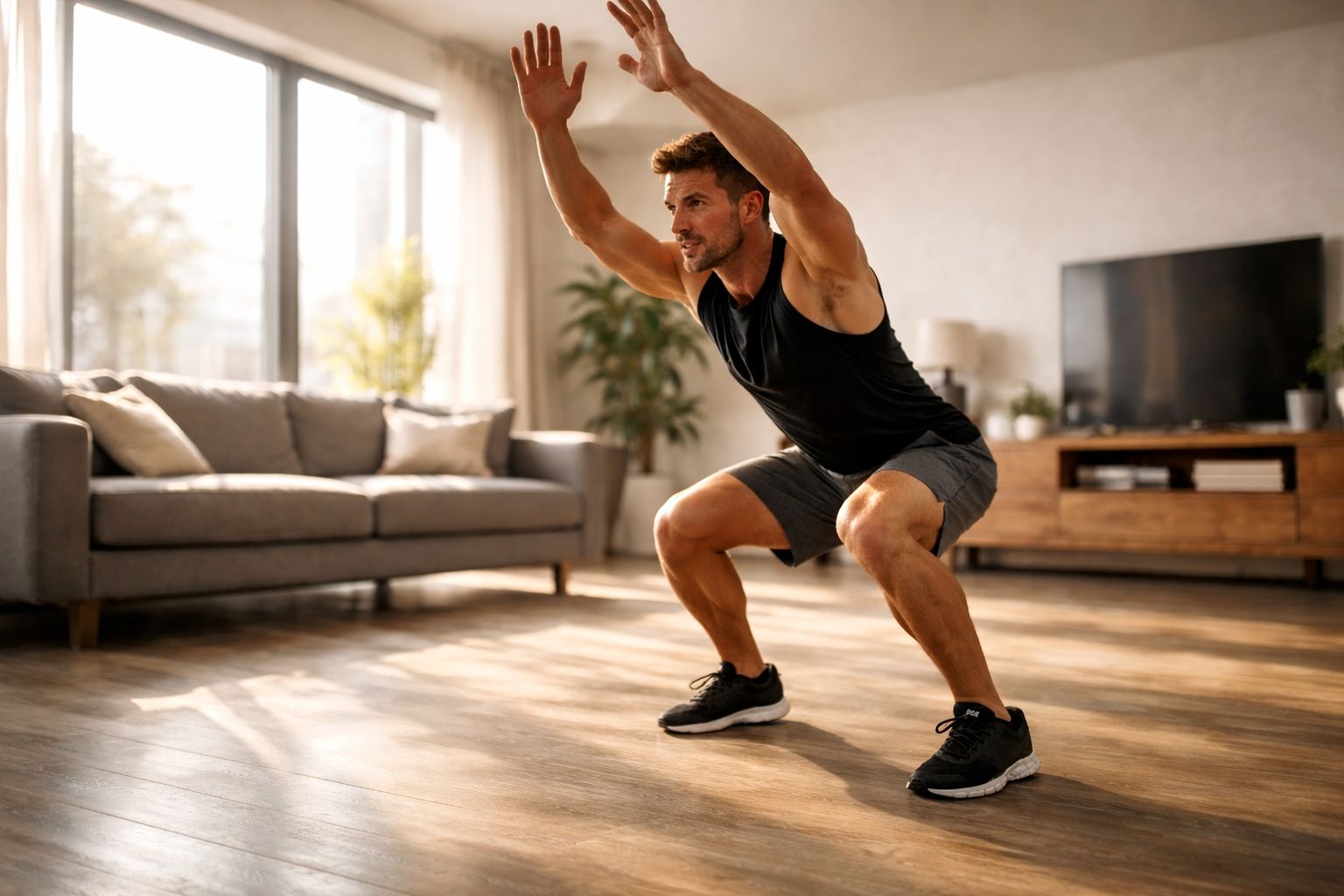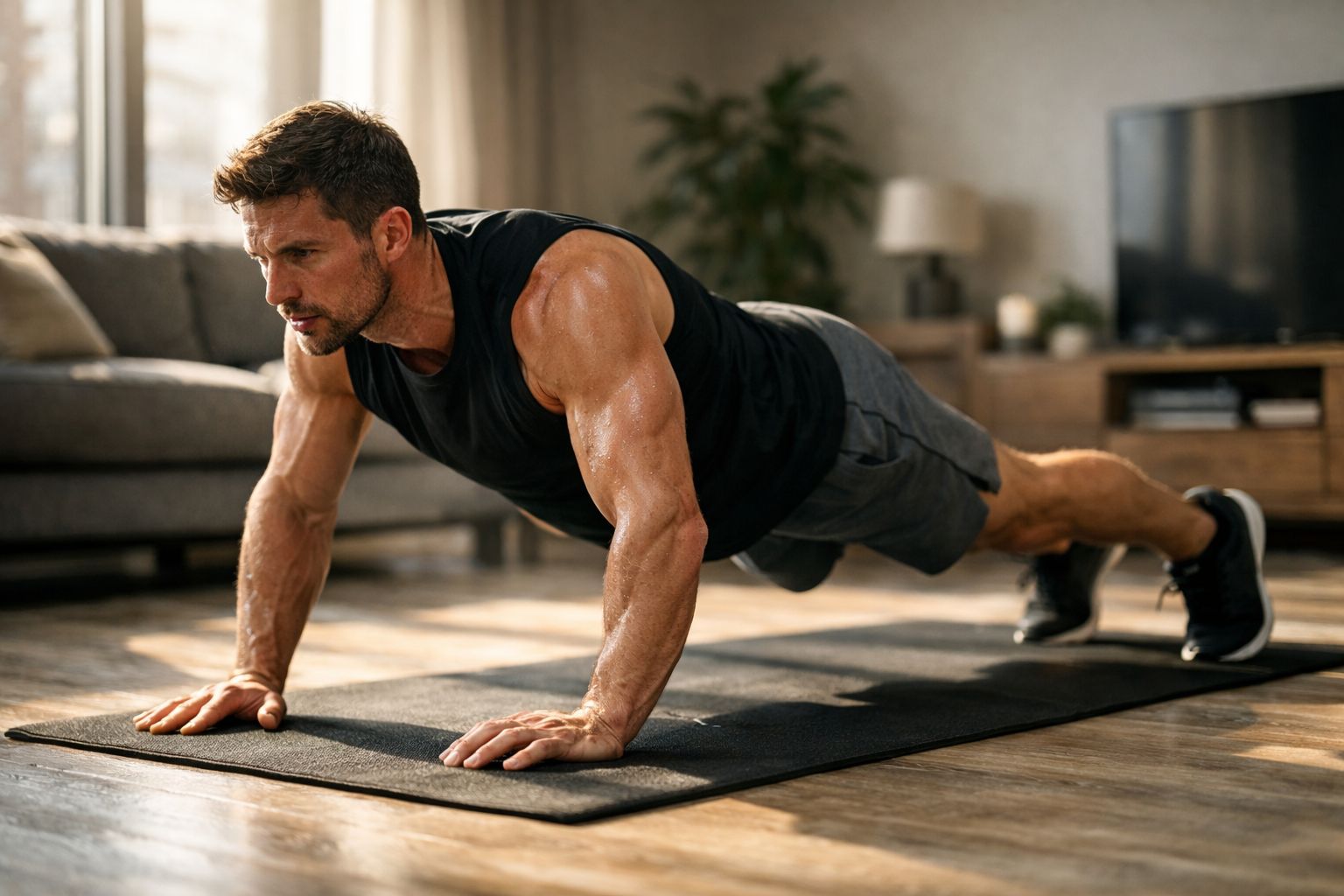
There is something deeply freeing about knowing your workout is never tied to a gym, a schedule, or a piece of equipment. A full body bodyweight workout strips fitness down to its most essential form: your body, gravity, and intention. Whether you are in a hotel room, a park, a living room, or your backyard, you have everything you need to train strength, endurance, mobility, and coordination. Bodyweight training is not a shortcut or a compromise. When done correctly, it is a complete system that challenges muscles, joints, lungs, and mindset in a way machines never fully can. This style of training builds usable strength, reinforces healthy movement patterns, and develops control over your own body, which is the foundation of athleticism at any level.
A: 15–35 minutes is plenty if you push the effort and track progress.
A: Start with incline push-ups on a counter/chair, or do negatives (slow lowers).
A: Use towel rows in a doorway, table rows, or isometric “pull and hold” squeezes.
A: Not usually—leave 1–2 reps in reserve most of the time for better recovery and form.
A: 2–4 times per week works well—adjust intensity and keep improving reps/tempo.
A: Add reps/rounds, reduce rest, slow the tempo, or switch to harder variations.
A: Shorten range, try reverse lunges, strengthen glutes, and keep knee tracking with toes.
A: A few minutes of easy breathing + hips/chest/ankles can help, but consistency matters more than perfection.
A: It can build muscle—progressive overload still works with bodyweight when you progress smartly.
A: 3 minutes: 20s mountain climbers, 20s air squats, 20s plank—repeat 3 rounds.
Why Bodyweight Training Still Dominates Modern Fitness
Bodyweight workouts have stood the test of time because they work with human mechanics rather than against them. Movements like squats, push-ups, lunges, planks, and hinges mirror the way the body naturally moves in daily life. Instead of isolating muscles, these exercises encourage coordination across multiple muscle groups, teaching the body to work as a single, efficient unit. This not only improves strength but also enhances balance, posture, and joint resilience. Another major advantage is scalability. The same movement can be adjusted to fit a complete beginner or an advanced athlete simply by changing tempo, leverage, range of motion, or volume. This makes bodyweight training sustainable over the long term, which is often the missing ingredient in fitness success.
The Anatomy of a Complete Full Body Workout
A truly effective full body bodyweight workout hits every major movement pattern rather than chasing muscle groups individually. Lower body movements challenge the legs and hips while also stimulating the core. Upper body pushes and pulls develop the chest, shoulders, back, and arms while reinforcing shoulder stability. Core engagement is woven into nearly every movement, training the trunk to resist unwanted motion rather than just performing isolated crunches. When these patterns are combined into a thoughtful sequence, the workout becomes more than exercise; it becomes movement practice. You are not just burning calories or building muscle, you are teaching your body how to move better under fatigue, which carries over to sports, work, and everyday life.
Building Strength Without Weights
One of the biggest misconceptions about bodyweight training is that it cannot build real strength. In reality, strength is about force production relative to body mass, and bodyweight exercises excel at developing this quality. Slowing down repetitions increases time under tension, making even basic movements feel intense. Pauses at the bottom of a squat or push-up force muscles to work harder without adding load.
Single-leg or single-arm variations dramatically increase difficulty by shifting more responsibility to one side of the body. Over time, these progressions lead to noticeable improvements in muscular strength, joint stability, and confidence. Many people are surprised to discover that mastering advanced bodyweight variations can be just as challenging, if not more so, than lifting heavy weights.
Turning Any Space Into a Training Zone
One of the greatest strengths of bodyweight workouts is their adaptability to any environment. A small hotel room becomes a training studio when you clear a few feet of space. A park bench transforms into a tool for step-ups, incline push-ups, or triceps work. Even a staircase can be used creatively to add elevation or intensity. The key is learning to see your surroundings as opportunities rather than obstacles. Training in different environments also adds a mental challenge, keeping workouts fresh and engaging. When fitness is no longer confined to one place, consistency becomes easier, and consistency is what ultimately drives results.
Conditioning, Fat Loss, and Endurance Benefits
A well-designed full body bodyweight workout does more than build strength; it also pushes the cardiovascular system. Moving continuously from one exercise to the next elevates heart rate and challenges endurance, creating a powerful conditioning effect. This style of training burns calories efficiently while preserving muscle, which is ideal for fat loss and overall body composition. Because many bodyweight movements engage large muscle groups simultaneously, they demand more oxygen and energy, making the workout feel intense without the need for long sessions. Over time, this improves work capacity, meaning you can handle more physical activity with less fatigue, both inside and outside of workouts.
The secret to long-term success with bodyweight workouts lies in progression. Doing the same routine forever eventually leads to plateaus, but bodyweight training offers endless ways to evolve. You can increase repetitions, slow the tempo, reduce rest, or move to more advanced variations. You can also focus on improving range of motion, control, and breathing. These subtle improvements add up over weeks and months, keeping the body adapting without excessive strain. Because bodyweight training is generally lower impact than heavy lifting, it is also easier on the joints, making it a sustainable option for long-term fitness. This longevity is especially valuable for people who want to stay active and capable well into later life.
A Workout That Fits Real Life
The true power of a full body bodyweight workout is how seamlessly it fits into real life. There is no commute to the gym, no waiting for equipment, and no excuses tied to time or location. You can train for ten minutes or forty, depending on what your day allows. You can use it as a standalone routine or as a complement to other forms of exercise. Most importantly, it builds a sense of independence and self-reliance in your fitness journey. When you know you can train anywhere, fitness stops being something you schedule and starts becoming part of who you are. That shift in mindset is often what turns short-term effort into a lifelong habit.